Saturday, 9 May 2015

What the Salman Khan case tells us about our society

Anyone who watches news will be aware of the details of the case. Hence I will not delve into them here. I want to put forward a few observations on the basis of the events surrounding this case. These are disturbing to say the least and need attention from all stakeholders.

  1. Pending cases - It says a lot about our judicial system when it takes 13 years for a verdict to come out and that too at the trial court level. We have the High Court and Supreme Court above this and hence there is no clarity as to when the final decision will come out. Just one of the many graphics detailing this sorry state is this. The government and judiciary are at loggerheads over the National Judicial Appointments Commission (NJAC). One prays for the country's sake that this gets resolved soon and that we set up courts to free up the backlog.
  2. Hero worship - Hero worship is probably present everywhere in the world. However India must be unique in the extent to which we carry this mania to. Salman Khan may be a good person at heart, I do not know. Fortunately or unfortunately one cannot (or should not) buy one's way out of legal trouble by simply good behaviour. There is a very simple reason. We do not have a society  which accepts blood money and lets the guilty go scot-free. However to his many fans Salman is beyond reproach. This is a very dangerous thing to have in society. Recall the similar reaction when Jayalalitha was convicted and jailed. Society should not give an impression to its prominent citizens that they are above the law.
  3. Ivory towers - There have been a few reactions, especially from the rich which seem to sympathise with Salman Khan rather than with the victim. The singer Abhijeet and the jewellery designer and daughter of Sanjay Khan, Farah Khan Ali immediately come to mind. There is a certain disdain which is apparent towards the weaker and poorer sections of society.
     Take the latter for example. She is Sanjay Khan's daughter. I understand that this gentleman owns a resort in Bangalore where the rates are higher than those charged in five-star hotels. So possibly this lady has known only wealth from her childhood. One wishes that such people at least spare a thought for the poor people in our society. Alia Bhatt had a more balanced reaction, where she expressed sadness but did also say that Salman was in the wrong.
  4. Parental upbringing and the role of values - This is a more controversial point. What upbringing do we have in our societies when we have reactions of disdain towards the poor, and open admiration for our "idols" in spite of they being in the wrong? We have examples of people like Narayana Murthy, Azim Premji in India itself who are known for their simple living and values in spite of their immense wealth. These are the models I would like to have. 
I strongly believe in individual freedoms. However I feel that we have a lot of misplaced admiration. We seem to admire people for all the wrong reasons. Salman Khan, Rajinikanth et al are after all people. I do not understand the mania of their followers. Do admire them, but how does one justify the mania? Do respect the good they have done, but what benefit does the fan (short for fanatic, by the way) gain via his "hero worship"?

Sunday, 26 April 2015

Time for a Radical Re-think on Agriculture?

This post has taken help from the articles mentioned at the bottom and has been written inspired by some posts by Anshuman Narain on Facebook.

Food in India has been associated with divinity for a long time. It is said to be the sacrificial offering to the fire in the human body. Krishna says in the Gita that he is this fire. He also talks about how food ultimately comes because of our deeds. There are concepts like annapoorNaa, Saakambharee and annalakshmee. Hence in this land, as an extension the producer of this food (the farmer) deserves a place of honour.

Of late and over many years, we have heard tales of farmer distress, crops getting destroyed due to various reasons, suicides etc. We see this happening year on year. Every time this happens there is a huge hue and cry by whoever is in the opposition, the media highlight and furiously debate it, the government promises relief measures and then everything is forgotten till the next calamity. Rightly or wrongly farmers are one of the largest voting groups and hence wield immense power. Many of our political leaders were farmers (they still claim to be when one asks them for their profession, the latest example being the Karnataka CM). I am not an expert but some of our problems are well known:

  1. Fragmented land-holdings
  2. Poor irrigation and hence over dependance on rains
  3. Low penetration of crop insurance (the other side of the coin being insurance frauds)
  4. Poor efficiency and hidden unemployment (GDP contribution ratio to employment ratio is low vis-a-vis, say, service).
  5. Skewed markets favouring middle men.
  6. Controversial procuring mechanisms (think of the debates over MSP or minimum support price)
  7. Inefficient and insufficient storage for procured items.
  8. Poor transportation measures increasing time gap from farm to plate.
When we are under the Britishers we had them to blame. Who do we blame today? On one hand we have hailed dams as the temples of modern India, on the other hand we have the Narmada Bachao Andolan and opposition to the Tehri Dam. Further I understand that in today's India, where there is huge discussion going on about tax evasion and black money, agricultural income is not taxed at all.

We have seen a huge movement against corruption which was apolitical. It is a different matter that this led to the formation of another political party. We have a PM who seems to be in a hurry to change the country. Can he not ask for a radical overhaul of our agricultural system?

  1. Completely decentralize agriculture - the central government is too far, empower the gram panchayats.
  2. Keep a stringent central monitoring mechanism in place - the local bodies should not monitor their own activities.
  3. Comprehensively EDUCATE people, especially farmers on the benefits of pooling resources, ensure formation and efficient working of farmer cooperatives - better bargaining power. Also we have to ensure that farmers are actually educated and not left illiterates.
  4. Invite public and private companies to invest in roads and storage infrastructure (both normal for dry crops and cold chain-related for fruits and vegetables).
  5. Link NREGA and farming comprehensively. NREGA should be comprehensively linked with developmental and productive activities.
  6. FINISH the discussion on inter-linking rivers and either dump it or start it. Lot of rivers, especially the non-Himalayan rivers see significant drop in their flows during the dry season. Interlinking can probably help to even out the flow and reduce dependance on dams - we can focus on irrigation canals only instead. These canals can be used in two other ways - to cover them with solar panels like it has been done in Gujarat, and also as transportation channels revolutionizing rural transport.
  7. Apart from helping improve irrigation we should also focus on drip irrigation. Imagine the increase in productivity and production if we can convert areas like the Kutch, Thar Desert and interiors of Odisha, Telangana etc. for agriculture!
  8. Increase efficiency and reduce over employment - for this we need extensive coverage of high yield varieties, access to fertilizers and pesticides, good farming practices.
  9. At the same time we should protect our bio-diversity and increase use of natural and organic methods. We have an abundance of cattle wealth. Their dung and urine can be useful as manure. Further varieties which have been traditionally used may be more resistant to heat, pests etc. Traditional knowledge should be tapped to the fullest extent possible.
  10. Inform people about crop insurance. However this alone will not help as many may not be able to afford it or may become ineligible for insurance payouts once they default on their loans. This is the reason I keep coming to consolidation and cooperatives. 
  11. There should be clarity on MSP. Increasing MSP can help farmers, however this leads to inflation which will impact the normal middle class anyway. The increased inflation may come back to hurt farmers again.
  12. We also need to realize that we are a country where only a small percentage of the population today pays income tax. At least the larger farmers who own significant holdings should be brought under taxation. This is not related to agricultural reform. However I wanted to bring this up while I am on this topic.
  13. Get comprehensive changes to the PDS (public distribution system). There is no point in procuring huge quantities and then squandering them. The correct recipients should be properly targeted. Aadhaar can play a huge role here.
  14. Rationalize our APMC system, reduce the role of middle men and ensure benefits go directly to farmers. The efficiency-related savings can be passed on to consumers.
  15. To do all of this there is a comprehensive centre-state debate required. People have to sit together and hammer things out.

We have people like APJ Abdul Kalam, MS Swaminathan and Narendra Modi who have vision. It is high time we think big, think radical and change our agriculture for good.

References:
  • http://economictimes.indiatimes.com/news/economy/agriculture/why-crop-insurance-schemes-fail-poor-farmers-when-they-are-needed-the-most/articleshow/47052185.cms
  • http://www.livemint.com/Politics/bYMbXRsL3eYQw2Bp4iMaXI/Narendra-Modi-promises-higher-support-price-to-farmers.html
  • http://www.dnaindia.com/india/report-quiet-reforms-by-narendra-modi-double-edged-sword-2040061
  • http://economictimes.indiatimes.com/news/politics-and-nation/view-new-land-bill-will-win-not-lose-votes-for-narendra-modi/articleshow/47057364.cms

Sunday, 19 April 2015

On Net Neutrality - Part 2

This is in continuation with my earlier post. First of all I am happy to report that Mr. Gopal Vittal, MD and CEO of Airtel (South Asia) has put out a clarification which in many ways echoes what I had written earlier.

Further I feel that we seem to be hearing only apocalyptic and hysterical views on net neutrality. Those supporting net neutrality have a good point to make. However they are not talking about the other side of the coin - how to compensate the huge investments made by companies, issues of security etc. As an added example look at Alok Kejriwal's post in today's Economic Times. He gives advice, talks about why net neutrality is needed. It would have been nice had he elaborated further on his advice. The TRAI chief has come out with a statement where he advises saner discussion.

So I am writing this post to talk about a few steps which can be done in this direction.

  1. The government can reduce the price of spectrum or increase the quantum of spectrum available for telcos. This can take away the argument about bandwidth-intensive free applications hogging bandwidth and also about the need for returns of huge spectrum-related investments. However given the government's stand today the possibility of the former happening. However the government can surely look at increasing the quantum of spectrum available.
  2. Telcos can look at launching this product first for in-house customers. For example make accessing customer service portal free. Then this can be extended to other companies for their premier customers (only). For example,  banks have high net worth (HNI) and private banking customers. Plus they have a clientele (like Premiere Banking for ICICI Bank) where the customer is not a private banking customer but puts in money above a certain quantum every month. Amazon and Flipkart offer some additional services to customers who pay a membership fee. These companies can extend services which consume bandwidth to these customers using the toll-free data (TFD) platform.
  3. Gopal Vittal has clarified that airtel stands and will continue to stand for net neutrality. However, now I will take an extreme case now. Taking a worst case scenario in the future, if net neutrality is breached on the basis of better speed for extra payments - the government can always put in a minimum threshold of speed whereby the slowest speed must be equal to or better than the average speed available where no extra payment is made.
Any further thoughts are welcomed!

Sunday, 12 April 2015

On airtel and Net Neutrality

First of all a disclaimer - I currently work at airtel, specifically airtel Business which is the B2B enterprise division. While I may justifiably be accused of having a bias, it also gives me an opportunity to have some idea on what I am talking about. Further I am writing this in a purely personal capacity, on MY  personal blog. This is in no way an official statement.

There seems to be a debate raging on how airtel has "dealt a blow to net neutrality" by its alleged tie-up with Flipkart, so much so that the company has also felt the need to clear the air. Apparently the defence put up by Flipkart has been "debunked". Refer to this. I am all for net neutrality, but thought I would share my perspective also.

Now before I clear a few things up let me share some background information. Today we consume broadly two kinds of services via mobile phones - voice and data. Though the backbones to carry both would be the same, the ways they are treated in are different due many reasons - technological, historical and especially important in the Indian context, regulatory. At the risk of oversimplifying, voice includes SMS and (normal) calls. Data covers everything provided via 2G/3G/4G - Internet on mobile phones.

Further India is one of the most competitive markets in the world where we have had many players per circle, more than in (especially) western markets. This led to all the operators bleeding badly a few years back. In the past few quarters telcos have been doing away with freebies and now it is being said that there may be an actual increase in rates also. Why is this? Telecom is a highly capital-intensive sector and returns accrue over years if not a decade. Telcos spend thousands of crores on acquiring spectrum. Especially after the so-called 2G scam this is more and more being treated as a natural resource which can only be auctioned and not allocated. Further there is a revenue-sharing concept where the telcos have to pay a portion of their revenues to the government.

Given this background services like Whatsapp and Viber started eating into SMS revenues and then voice revenues also. Due to hyper-competition rates had fallen and as I said earlier there is now a correction underway. This is the background in which airtel decided to launch specific packs for the so-called over-the-top (OTT) players like Whatsapp. Simply put OTT players provide services that are directly consumed by you and me without an intermediary like a cable operator. It can be argued that this is against the concept of net neutrality. However I would like to give some context here. Facebook has an initiative called internet.org which is about providing "affordable" Internet access to consumers. The problem is that Facebook is not making any sacrifices here. The people making the sacrifice are the telcos who provide the access. Facebook is free for users. It does not charge entry fees. It makes money via ads. So there is clearly a selfish motive behind this "affordable Internet". This has been criticized by telcos as this is charity with someone else's money.

Further there is a regulatory point to be made here. Whatever is done by the telcos In India the government wants something called lawful interception (LI) to be available. Whether this is desirable or not is a separate point and is not in the scope of this post. Under LI the government should be able intercept and decipher all communication. Telcos have to provide such facilities to the government. Monitoring OTT players is not that easy as the servers are not hosted in India. Similarly cloud is a concept that is rapidly catching companies' attention today. However PSUs/government does not have so much. Rightly or wrongly there is an impression that a cloud service is less secure. This is probably a major reason why Microsoft is now planning to set up data centres in India. However I am digressing.

Now coming back to the idea behind this post, in voice services there is a concept of toll-free number. Basically the caller does not get billed. The company taking this service gets billed on behalf of its customers. This is mostly used for customer care and for sales enquiries. All the 1800- numbers we see are Indian toll-free numbers. What airtel is launching now is a similar concept, but for data services. This is called toll-free data (TFD). There are a couple of points to be noted here.

  1. There is no preferential access given to say a company which has signed up for this over any other. Thus if Flipkart signs up and Snapdeal does not, all Flipkart and Snapdeal customers visiting the respective mobile websites will be able to access them at the same speed. However only airtel users visiting the mobile website of Flipkart will not be charged. These charges will be borne by Flipkart. However as pointed in the "debunking" article above it is true that in this case even after the data pack (1GB, 2 GB etc.) is exhausted speed of access to Flipkart may not decrease (like it would for a non-Flipkart site). I will return to this point shortly.
  2. With toll-free voice we do not hear accusations that the telco is supporting company X over Y by providing it a toll-free number. The company X chose to provide a toll-free service. A customer of X chose to use it. Similar logic can be applied in the case of toll-free data also. There is no form of coercion anywhere.
  3. The earlier article takes a reference of Norwegian interpretation of net neutrality and wants to use it in an Indian context. Going by this logic we should wonder whether the author(s) of the article is(are) prepared to pay rates proportionate to those in foreign markets, rather than what we have in India today.
  4. We live in a world of disruptive innovation. Things can change in a very short period for established market players. Those ranting against the toll-free data service may need to think about this.
  5. Coming back to the last part of point 1. I believe the customer is intelligent enough to make a distinction between good service and bad service. The critics of TFD have to realize that if I am not happy with X, whatever they may do I will want to shift to a different provider. And if I truly like Y for their services, I would want to bring pressure on them to provide me a free service like X!
  6. Facebook Zero and Wikipedia Zero are similar concepts. We do not hear about them because these have not been hyped up. I for one have not seen posts criticizing Facebook or Wikipedia for driving traffic away from other websites! There is an article here, as pointed out by my former engineering batchmate, Abhishek Nalin.
So I believe there is over-reaction and media-hype over a non-issue, the proverbial making of a mountain out of a molehill. My basic points are simple.
  1. Let us understand before we comment
  2. Let us analyze with logic rather than emotion
  3. Innovation will continue. Let us debate as much as required and then proceed. There always will and should be differing view points.

Tuesday, 10 February 2015

A Golden Chance for India - The Delhi Elections and Stakeholders

The Aam Aadmi Party (AAP) has just swept the Delhi Assembly polls. I want to spend a few minutes on what it means for the various stakeholders.

AAP: 
 1. Obviously the centre of attention and rightly so. This is a golden chance for them to prove that they are actually different and can make a huge improvement to our society.
2. They have consistently projected a holier-than-thou attitude and out of trust or naivety people of Delhi have given them a massive mandate. Modi has a big mandate but is crippled due to lack of numbers in the Rajya Sabha. Kejriwal does not have that excuse or handicap. There is no legislative council in Delhi. If he wishes he can radically change the face of Delhi. So given the nature of his victory he will be held to higher standards. Kejriwal must remember that the mightier fall harder.
3. Kejriwal has cautioned his party against getting carried away. The way the BJP fought under Modi's name the AAP fought under Kejriwal's. It now remains to be seen whether other members of the party have the same prudence that Kejriwal has displayed or whether having tasted power the party will descend into politics-as-usual. For the state's sake and the country's let us hope that does not happen.
4. From the vote share statistics it looks as if the AAP was able to successfully attract the Congress' support base. People in India do not have a very long memory. For all we know this support base can go back to the Congress during the next election unless the AAP is able to truly prove its worth.

BJP:
1. Undoubtedly a humbling defeat for the party. They chose to make it a Modi vs Kejriwal election. Now predictably they are trying to shield Modi for the defeat.
2. Partners and obviously opposition parties are taking digs at the seeming "invincibility" of Modi being broken. This is a good opportunity for the BJP to introspect. There are multiple lessons for the party.
3. The party should stop parachuting people who jumped ship from the opposition and should give more responsibilities to those who have been with the party throughout.
4. There should not be hubris about the earlier Lok Sabha mandate. There should be more maturity and humility going forward. It has been trying to muscle in onto partners' territory also in some states. This may be the time to go slow and think this through.
5. Let Modi not be the face of eveything. The BJP touted itself as a cadre-based party and as a party with a difference. This was lost as soon as Modi came onto the national stage. This may be good for victories, but can also lead to black eyes.
6. However all said and done, the vote share of the BJP is almost intact. This means people still believe in the party and/or Modi. This is the silver lining.

Congress:
1. The Congress today is probably the best example of what happens to those who abuse power in a democracy. Earlier in the (rest of) Andhra Pradesh (AP) state elections the Congress drew a blank. This is the second instance. The Congress was in power at the centre, Delhi and (united) AP for a long time. However the electorate gave a stunning rebuke. This is nothing less than a slap in the face.
2. This is a serious time for the Congress to revisit its grassroots and have a re-look at its leadership. Ajay Maken has been left to fend the press and there is absolute silence from the "first family". While  Modi and Kejriwal can be accused of over-communicating today the Nehru-Gandhis and the Congress in general insist on remaining aloof. 
3. There have been multiple calls from across the country to change the leadership. It is high time the party does so. However the chances of that actually happening are low to non-existent. Maken has already tendered his resignation. Probably AK Antony will head a committee set up to investigate reasons for the defeat decimation. The report will blame something or someone else and the Congress will reaffirm its faith in the Nehru-Gandhis. The founding fathers in their graves will put a washing machine's dryer to shame.

Rest of the opposition:
1. Kejriwal's win is a whiff of oxygen to them. Whether it will ensure their survival or whether it is dying burst of the flame remains to be seen. Post the central elections there have been frantic efforts to form "an alternative to the Congress and the BJP" or a "secular bulwark against the communal BJP". It has seen the likes of Nitish Kumar and Lalu Prasad Yadav coming together. The TMC is in disarray because of the Saradha scam. This victory may become a rallying point for the rest of the opposition. 
2. However in line with the "I am different" rant of the AAP, Kejriwal may not want to align with these people. There is also a risk that the AAP will eat into the vote share of these parties in their respective states. So it remains to be seen whether these parties will welcome the AAP to contest elections in their own states. 

India:
1. I truly pray for the sake of the country that Kejriwal works miracles in Delhi. Given his mandate he can. I want him to bring in more empowerment, more digitization of services and the likes which, to paraphrase Modi, will maximize governance and minimize government. I am reading a nicely written book by Mihir Sharma called Restart. The author rightly says that proper reforms taken up in one state can change the country.
2. Today we are in the era of competitive politics. While this competition has always been about things like who will give more subsidies, free stuff etc. today it is also about development. The young Indian electorate of a state would love to see successful schemes from other states being implemented in the home state also. Thus it can become a question of survival for other political parties to emulate the AAP, if it is successful.
3. The AAP also seems to make socialist noises from time to time. Undoubtedly the government has to take care of the poor, needy and deserving. However the emphasis should be more on deserving rather than anything else. Let there not be free stuff for the sake of free stuff or populism.
4. Also let there not be witch hunting of corporates. Nobody claims corporates are epitomes of saintliness. However punish the guilty with transparency. Do not make it seem like a witch hunt, driving investment off.
5. Today India needs foreign investment. I refer to Mihir Sharma's book again. We cannot print money as that will lead to more inflation. We do not seem to have sufficient resources to invest in our needs ourselves. Maybe if we can decrease black money we may have sufficient resources. However this cannot be done in a day. Hence we need foreign money also. Let this not be driven away by the AAP.

At the end of the day I would love to see synergy between Modi and Kejriwal, two individuals who have radically transformed the way we look at India, its citizens and its politics. These two, working together can change the face of the country. This is a synergy which the country needs, and I cannot over emphasize this.

Saturday, 24 January 2015

Do we overly idolize our NRIs/PIOs?

Citizens of India, present or erstwhile, fall into different categories - native citizens, NRIs (non-resident Indians), PIOs (persons of Indian origin) and OCIs (overseas citizens of India). Modi wants to unit PIOs and CIOs under one category. At the risk of generalization I can say that most of the Indians abroad are Gujaratis, Malayalis, Punjabis and maybe Tamilians and Telugu-speaking people.

Those abroad, especially the non-resident Indian (NRI) has been a variously-regarded person in India. He has been reviled as a prime example of brain drain. He has been accused of abusing government subsidy via IITs/IIMs and then flying out at the first available opportunity. He has been accused of jacking up property prices to levels unreachable by the common man. Parents are afraid what may happen to their daughters married to NRI grooms.
He has also been admired for being a significant source of money inflow into the economy, especially in terms of USD. He has been admired for having held high the flag of India abroad. He has created a role model for others to look up to (whether the emulation will be in India or abroad is a different matter). He has created an image of Indians as hardworking and intelligent abroad. Parents also want NRI grooms for their daughters.

Earlier it was probably engineers and doctors leaving India after education. Today added to that number is the large number of (mostly) software-related professionals who go on both long-term and short-term assignments. Earlier there was not much government focus here. In fact the Ministry of Overseas Indian Affairs was probably created more to accommodate leaders in the cabinet than for any practical purposes. However now there is a lot more emphasis with a Gujarati being the PM and the support he has among Indians abroad.
 
In this context this article seeks to explore if we idolize them a little too much and whether this also puts them under a lot of pressure. In particular I am referring to those who voluntarily give up citizenship of India or are descendants of such people. This is their right, their choice, no questions asked about that. However I want to ask whether we should idolize a person who does not want to be looked upon as an Indian anymore. We seem to go into paroxysms of joy when we here about people of Indian origin taking up posts in governments abroad. Please note that the foreign governments consider them their citizens. "Our" guys consider themselves foreign citizens. For example, see what Bobby Jindal said and is going through now. The same happens with the Nobel Prize. Take a look at the list of Nobel laureates of India. Three of them voluntarily gave Indian citizenship up.

We Indians take an inordinate amount of joy in our past and very much like to rest on our laurels. These people abroad have made it on their own. We should be happy for them. However instead of just feeling proud that "our" guy has made it, we should question how these conditions can be created in India, especially in the areas of science and education. We should strive to create a scenario where people do not need to go out because their dreams may not be fulfilled here. As long as the currency of a foreign country is valued more than ours obviously it will carry monetary attractiveness. I am however talking about taking India back to the status it enjoyed in the ancient world as a knowledge centre (I am being atavistically proud now). Today foreigners already come to India either for the "exposure" it offers in terms of business environment, or after becoming religious, spiritual or cultural converts. I want the country to reach a stage (probably already on the way) where more and more inventions happen here, where scientific advancements out of India become commonplace. I want India to produce more and more quality PhDs. I want our institutions, both academic and research-oriented to produce more ground-breaking papers. In short I want India to occupy the place the US and now increasingly China occupy in the world today. Bas itna sa khwaab hain.

Sunday, 18 January 2015

A response to Brinda Karat - part 2 - an example of proselytization

This is in continuation with my last post where I had said I would give a personal example of how proselytizers work.

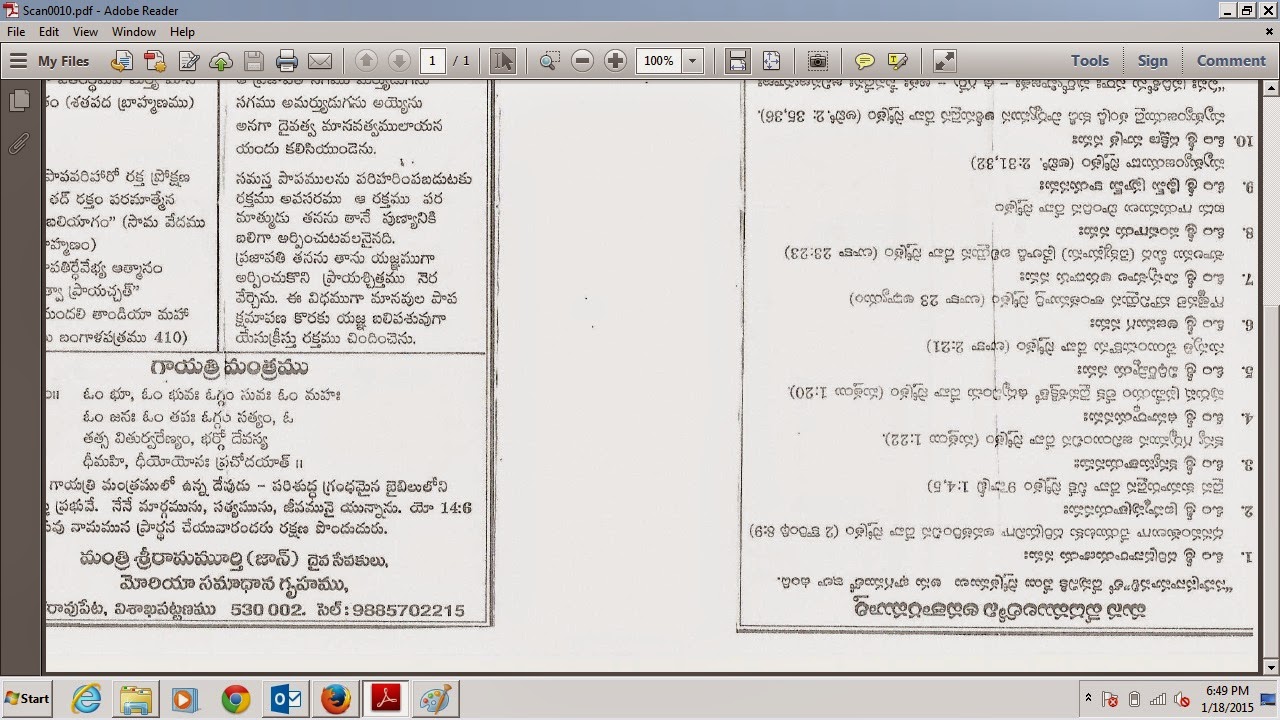
My father and I were in the Visakhapatnam beach some time last year. We were strolling when suddenly a lady walked up to us, gave us a pamphlet and walked away. I am reproducing half of this pamphlet here. There were some scanning issues with the other half. I have attached the screenshots of the original Telugu pamphlet.

Title - The incarnation in our Vedas

The pamphlet claims that the names which follow are part of a sahasranAmAvali. A Hindu would suppose that these nAmAs are part of the Vishnu SahasranAma
 
1. However the Vishnu SahasranAma is not part of any Veda as such. It is taken from the Mahabharata. So the pamphlet begins with a lie. Further against each line, sources in the Bible are given which means an originally Greek document has now been translated into Sanskrit! Further there is no concept of the many names of God anywhere in Christianity or in Abrahamic religions. Please correct me if I am wrong.

2. Also to the best of my limited knowledge at least some of the lines are grammatically trash (though an average layman may think otherwise).

3. There is obviously no Om in Christianity. I understand that "the Word" or "Amen" is a Christian equivalent. 

4. The names mentioned - daridranArAyana, brahmaputra, kanyasuta,umArtha, vidhirSTa, ajamuga, michchasoola arudAru, panchaga, phrim proom(?!), dakSina mAtra

5. What follows is too lengthy to type, but sounds like utter nonsense.

6. What follows seem to be either real or fake slokas from Hindu holy books which have been given a Christian twist.

7. But the highlight? It claims that the God mentioned in the gAyatri mantra is the same as that mentioned in the Bible! The translation given of the mantra is nonsense.